
Wallpaper Estimator
Wallpaper is sold by the roll, but what you really need is enough full-height strips. Enter your walls, ceiling height, roll size and pattern repeat, and this estimator calculates how many strips each roll gives, how many strips your walls need and how many rolls to buy — with an allowance for pattern matching and trimming, and an area-based cross-check.
- Free to use
- No sign-up
- Runs in your browser
Wallpaper roll calculator
Wallpaper Planning Kit
Wallpaper planning kit: Excel multi-room roll estimator (strip method), room measuring sheet, wall-by-wall strip planner, shopping list with batch numbers and a hanging checklist.
- Estimator (XLSX)
- Measuring sheet (PDF/DOCX)
- Strip planner (PDF)
- Shopping list (PDF, XLSX)
- Hanging checklist (PDF, DOCX)
Formats: XLSX, PDF, DOCX. Instant download after payment (link valid 72 hours, up to 5 downloads). AI-assisted: the templates were drafted with AI help and reviewed and laid out before publishing.
$5.00 USD, one-time 5 files · about $1.00 each
- Instant download
- 7-day refund
- Secure checkout by Stripe
7-day money-back guarantee. Full refund within 7 days of purchase, even after you download.
Free sample: Wallpaper Estimator (PDF, 55 KB)
Full refund within 7 days — see the refund policy and license.
Free printables
Single sheets you can print right now, no sign-up. The full pack adds every sheet in one download plus the editable files.
 Printable Wallpaper Roll Estimator
 Printable Wallpaper Measuring Sheet
 Printable Wallpaper Strip Planner
 Printable Wallpaper Shopping List
 Printable Wallpaper Hanging Checklist
Why the strip method is more accurate
Estimating by area — divide wall area by roll area — usually underestimates, because wallpaper has to be hung in full-height strips. Every roll leaves an offcut too short for another strip, and patterned papers waste extra length lining up the design. The strip method counts what really happens: how many full-height strips you can cut from each roll, and how many strips it takes to go around the room. The calculator shows both, so you can see how much the pattern costs you.
How the calculation works
- Add up the widths of all the walls you will paper.
- Divide by the roll width and round up to get the number of strips.
- Cut length per strip = wall height + about 4 in (10 cm) for trimming top and bottom + the pattern repeat (more for a half-drop match).
- Divide the roll length by the cut length and round down: that is strips per roll.
- Rolls = strips needed ÷ strips per roll, rounded up.
- Add at least one spare roll for mistakes and future repairs.
Roll sizes
| Roll | Width | Length | Coverage |
|---|---|---|---|
| US double roll | 20.5 in | 33 ft | about 56 sq ft |
| US single roll (priced as single, sold in doubles) | 20.5 in | 16.5 ft | about 28 sq ft |
| US 27-inch roll | 27 in | 27 ft | about 60 sq ft |
| Standard European roll | 53 cm | 10.05 m | about 5.3 m² |
| Wide European roll | 70 cm | 10.05 m | about 7 m² |
Always check the actual width and length on the product label — sizes vary between brands, especially for designer and imported papers.
Pattern repeat and match type
- Random or free match — no pattern to line up; least waste.
- Straight match — the pattern lines up horizontally across strips; allow one full repeat per strip.
- Half-drop match — each strip is shifted down by half a repeat; allow about one and a half repeats per strip.
- Large repeats (over 21 in / 53 cm) can reduce strips per roll sharply — for an 8 ft wall a 25 in repeat may drop you from 3 strips to 2 per roll.
Worked example
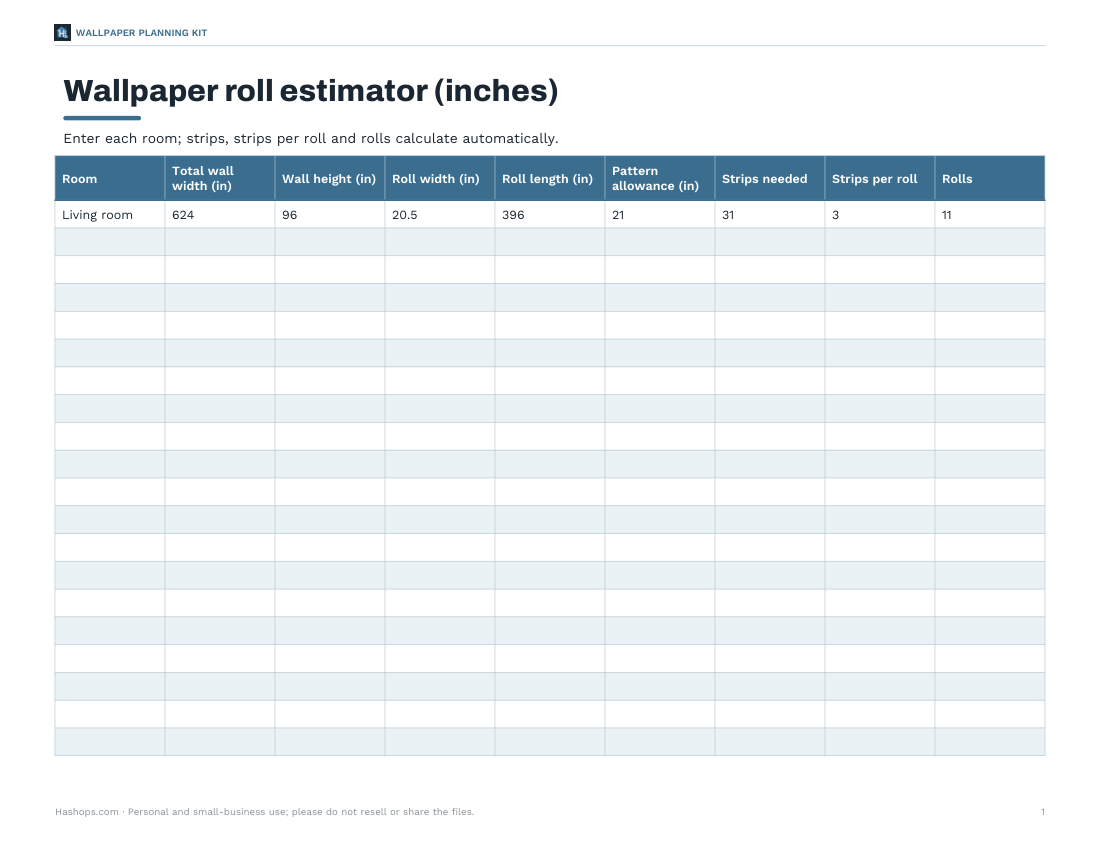
A 12 × 14 ft room with 8 ft ceilings has 52 ft of wall. With US double rolls (20.5 in wide) that is 31 strips. A 21-inch straight-match repeat makes each cut length 96 + 4 + 21 = 121 inches, so each 396-inch roll yields 3 strips. 31 ÷ 3 rounds up to 11 rolls; with one spare, buy 12 double rolls. The area check gives about 416 sq ft — only 9 rolls by area — showing how much the pattern repeat adds.
Doors and windows
Professionals rarely subtract windows, because short pieces above and below them still need matched lengths from full strips. A full-height door or a wide built-in wardrobe can save whole strips, so the calculator lets you subtract strips for doors. A standard 3 ft door is about 1.75 strips wide on 20.5 in paper — counting it as one strip saved is a safe rule of thumb.
Measuring accurately
- Measure each wall at its widest point, including the width of doors and windows.
- Measure the height from skirting board to ceiling in two or three places; rooms are rarely perfectly level — use the largest figure.
- Measure in feet and inches or metres and centimetres consistently.
- For a feature wall, only measure that wall; for stairwells, measure the longest drop.
- Note sloping ceilings, alcoves and chimney breasts, and add their side returns to the wall widths.
Feature walls and ceilings
For a single feature wall, the same method applies: wall width ÷ roll width gives strips, and roll length ÷ cut length gives strips per roll. Ceilings are measured the same way, but strips run across the shorter dimension, so use the room width as the “wall height” and the room length as the total width. Ceiling papering is best done with a helper and a paste-the-wall paper.
Buying tips
- Buy all rolls with the same batch (dye lot) number — colours vary between batches.
- Order a spare roll now; the same batch may not be available later.
- Check whether the paper is paste-the-wall or paste-the-paper and buy the right adhesive.
- Keep the labels: they show batch, match type and repeat.
- Unroll and check for defects before cutting.
What the template pack includes
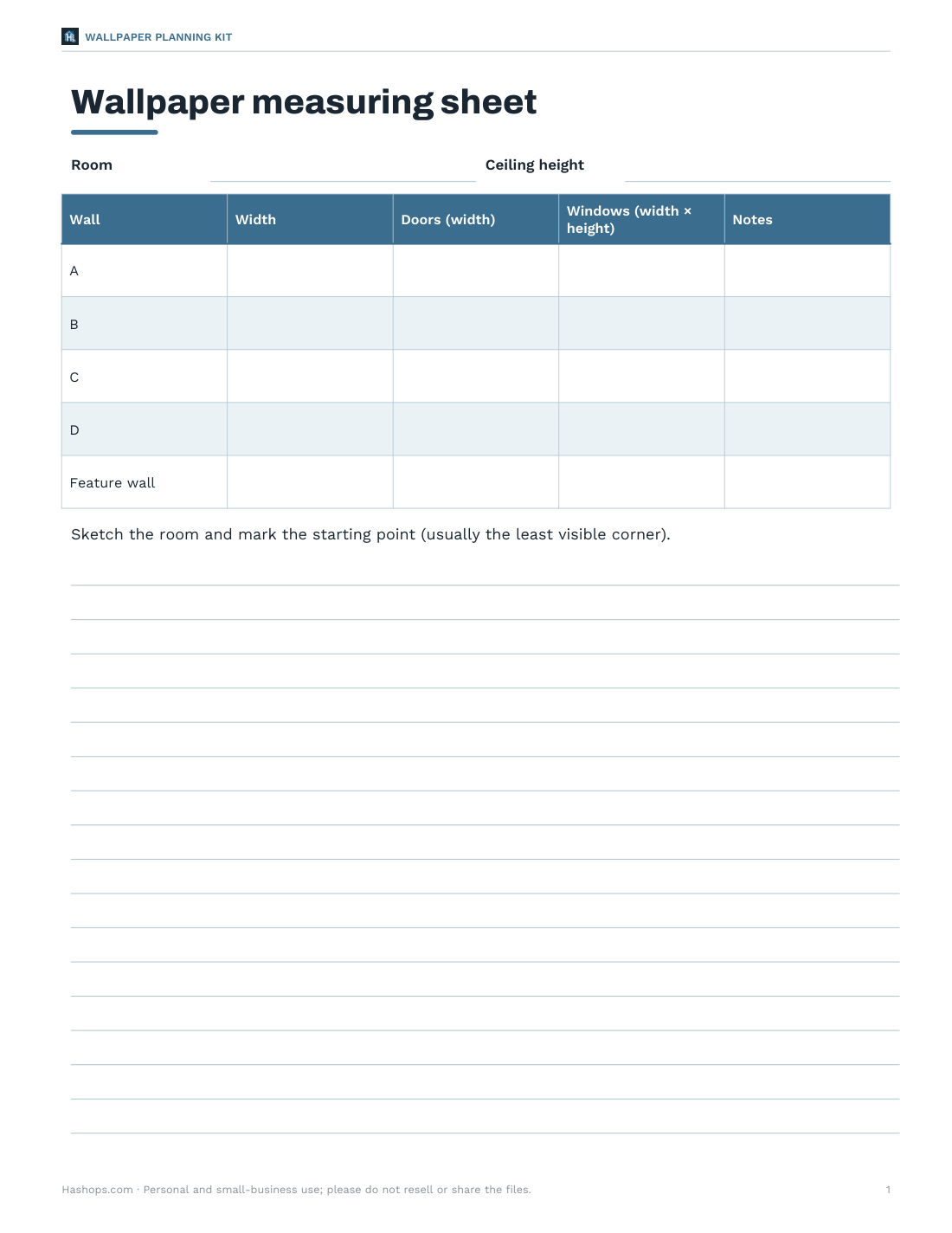
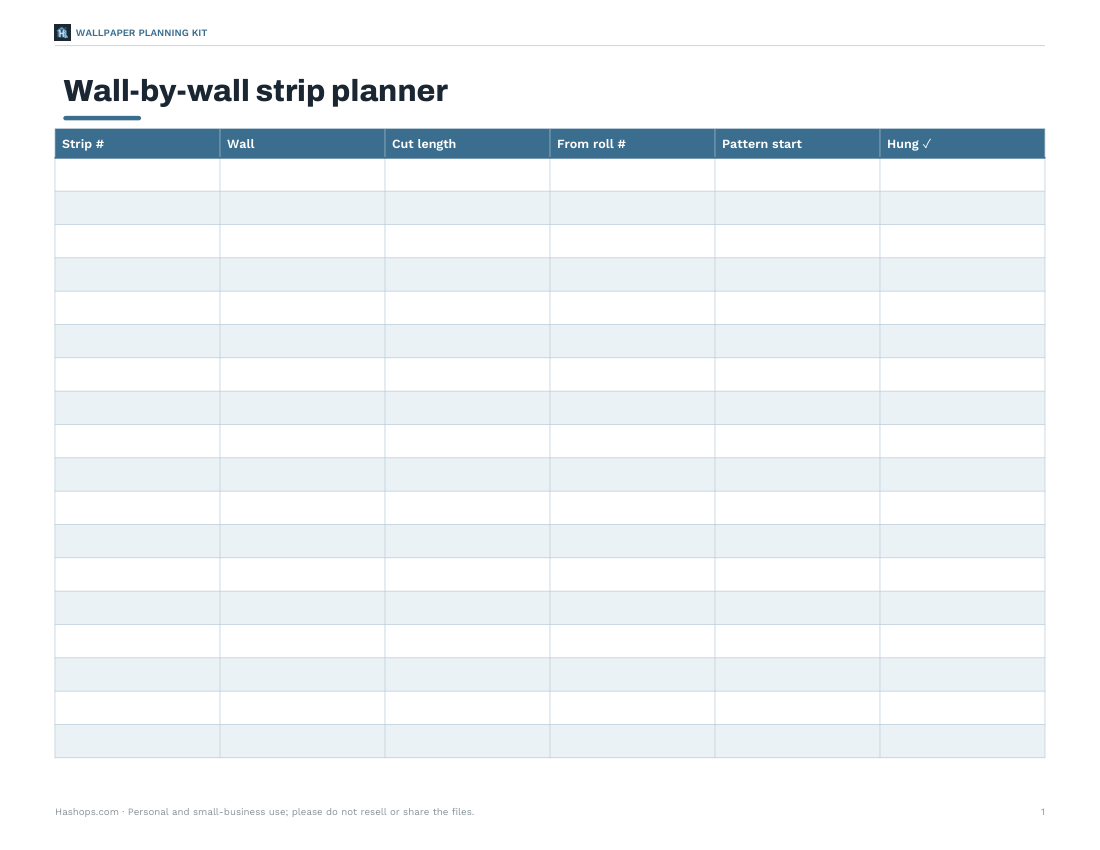
The printable kit includes a room measuring sheet, a wall-by-wall strip planner, an Excel estimator that repeats this calculation for several rooms, a shopping list with batch numbers, and a hanging checklist.
Privacy
The calculator runs in your browser; nothing is uploaded.
Frequently asked questions
How many rolls of wallpaper do I need for a 12 × 12 room?
With 8 ft walls, 20.5 in double rolls and a modest pattern repeat, usually about 9–10 double rolls; use the calculator with your exact details.
What is a pattern repeat?
The vertical distance before the design repeats itself.
Should I subtract windows?
Generally no; only subtract full-height doors or openings.
What is a half-drop match?
A pattern where each strip is offset by half a repeat, needing more paper.
Can I use leftover pieces?
Yes, for small areas above doors, below windows and inside alcoves.
How much extra wallpaper should I buy?
At least one spare roll from the same batch.
Is my data stored?
No, it runs in your browser.